Disclaimer: I am not a lineage master, nor am I authorised to teach or formally talk about Dzogchen. I am a practitioner who has attended meditation retreats led by Tenzin Wangyal Rinpoche since my first retreat with him, around 1997 in Poręba Wielka, Poland. What follows reflects only my personal experience, study and understanding, shared in the spirit of open reflection. Any errors or misunderstandings are entirely my own.
Readers of my previous posts will know this wasn’t my first retreat with Tenzin Wangyal Rinpoche, and that I’ve been practising meditation since I was a teenager. I’m 52 now, at the time of writing. I’ve also written before about the huge benefits meditation retreats can bring, especially for those who want to get to know themselves more deeply. But they’re just as valuable for anyone simply wanting to start a meditation practice.
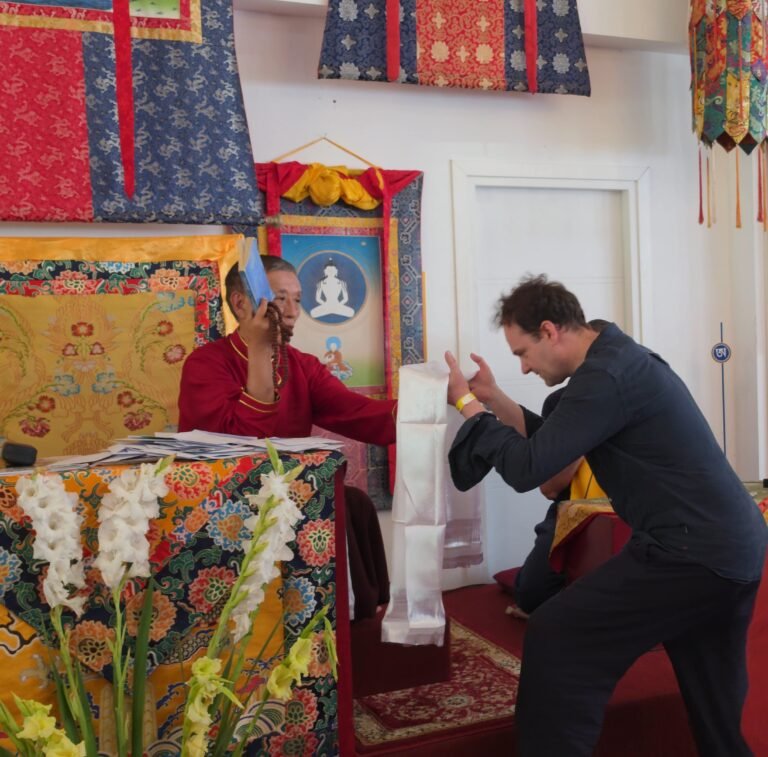
This summer, in 2026, I attended the second part of the Experiential Transmission of Zhang Zhung (Gyalwa Chaktri), a cycle that lasts five years. It was led by Tenzin Wangyal Rinpoche, who gave teachings on the practices of zhiné and trekchö.
ཨ
Zhiné is a practice of concentration and calm abiding that prepares the mind for Dzogchen meditation.
Trekchö is the actual Dzogchen meditation of resting in the natural state of mind.
Writing about the recognition of the natural mind within Dzogchen is, from the start, already a kind of failure. Not because the recognition itself has failed, but because there is ultimately nothing that can be grasped and turned into an object of description.
What follows is a humble attempt to use words and language, despite their limitations, to point towards the natural mind (rigpa).
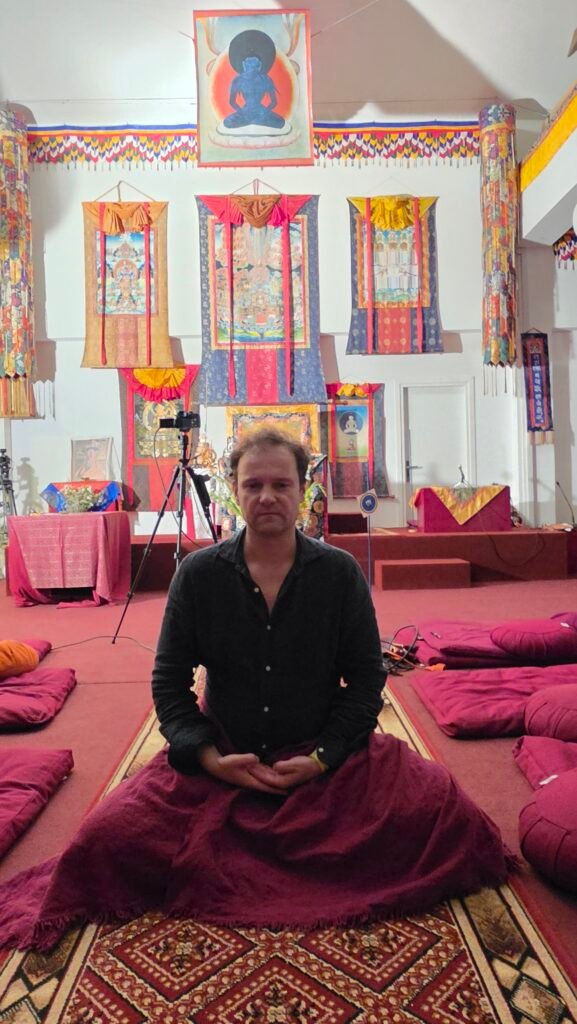
The retreat lasted six days, from 11 to 16 August. Each day was organised into two parts. We started with teachings at 10 am, which lasted an hour and a half. There was then a break of 30 minutes, followed by one hour of formal practice. After lunch, formal practice resumed at 3 pm for one hour. Then there was another break of 30 minutes, followed by teachings until 6 pm.
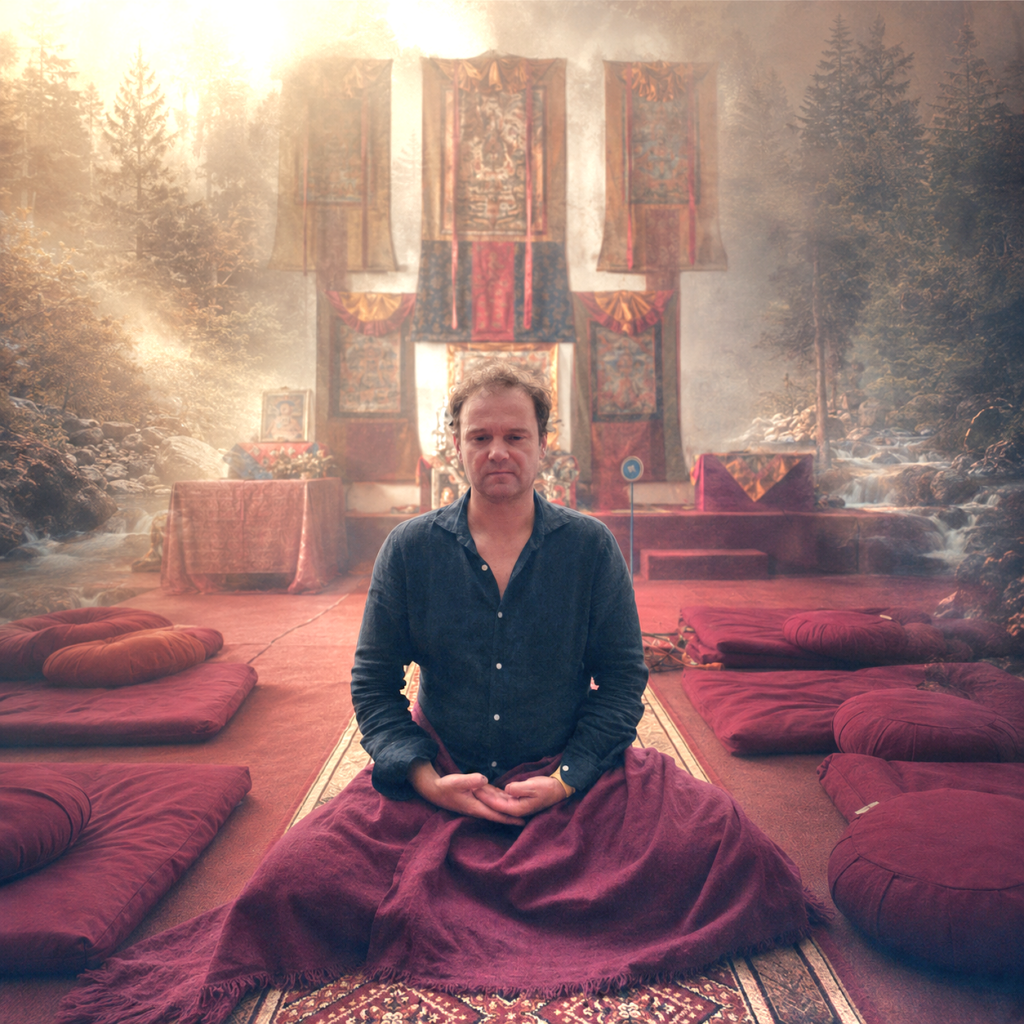
Day after day of Dzogchen meditation, it was a continuous abiding in the natural mind. What was present were an infinite spaciousness and lucidity of mind. Everything was connected, with no felt boundary between the two. A single point.
It felt like being a fish in water. Spaciousness was everywhere, within me and around me, with no boundary between the two.
The practice of zhiné has a particular purpose. It calms the mind and helps us recognise the moving mind, that constant train of thoughts which obscures the true nature of mind. Traditionally, zhiné is practised by focusing on the Tibetan letter A as an external object and this was the form we followed in our own practice. Our eyes stayed open, no blinking for the full hour, at least for me. The object acted as an anchor in the here and now. At the same time, we made a mental effort not to engage with thoughts of the past, present or future.
Once the mind became settled in stillness and thoughts subsided, we were ready to remove the letter A and rest our attention on the space itself in front of us.
This is where recognition of the natural mind can happen.
Then trekchö meditation begins
At this point, the line between subject and object collapses. Mariusz carries on as usual, but nobody’s standing at the centre calling any of it “me.”
In sound, there is silence.
In seeing, there is emptiness.
The brain still registers things such as sound, sight, understanding but nobody steps forward to claim it. Nobody says “I heard that” or “that’s my understanding.” It’s just there. (In everyday life I would say “I heard that” etc, but this is for the purpose of comunication.) It is more like hearing takes place, undestanding takes place…
There is awareness, but no owner of awareness. It has no centre or boundaries, yet it is present here and now, empty, clear and alive, like a river, a forest and life itself.
One way to say something about it would be: wherever “I am”, everything happens without “me”, and being present is a way to be and act.
Thoughts, emotions and feelings have the same qualities as this field of the natural mind. They are like drops of water merging with the ocean, reshaping and flowing, but always remaining one.
Another way to see it is as a triad: Mariusz, the process of experiencing, and the object being experienced. None of the three is separate from the others. In their nature, they are indistinguishable. All three share the same qualities: emptiness (spaciousness), clarity (openness) and luminosity (awakened light). It is like water being poured into water.
All of this is experienced subjectively, literally and not as a metaphor. In the same way, love is experienced literally as love, and anger as anger. If you have experienced love, you get my point.
Funnily enough, there is nothing special about the natural mind in the sense that “I” experience something special. Joy feels like joy, sadness feels like sadness, love feels like love and anger feels like anger.
However, every emotion and thought, everything observed, and all actions of body and speech are left as they are. They unfold and move through the mind without a place to stay, like images from a cinema projector with no screen on which to appear. If they manifest, they feel like a rainbow. There is nothing to hold or grasp. This is a metaphor for the natural mind recognising itself as empty and luminous.
Yes, I still need to pay the bills, eat food and sit on the toilet. I have a wife, interests such as studying mathematics, and various communities I belong to.
All of it is Dzogchen practice.
The shared experience and commentary above are merely a model of what it is truly about. It is similar to how different mathematical models and formulas are used to represent aspects of reality without being reality itself. So planes fly, smartphones work and equipment in hospitals saves lives. In a similar way, Dzogchen practice leads to liberation.
In this luminous silence of the natural mind, we discover that there is nothing missing and nothing to gain, yet it is perfect. This is not about personal skills or talents. For instance, my mathematics is not perfect, but I love studying it and improving my understanding.
So you might ask, well, I’m enlightened so I’m free and there is nothing else to do or care about? On the contrary. Now you can be anybody and do all the human activities you choose with passion, dedication and fun. You can fully experience life as a human.
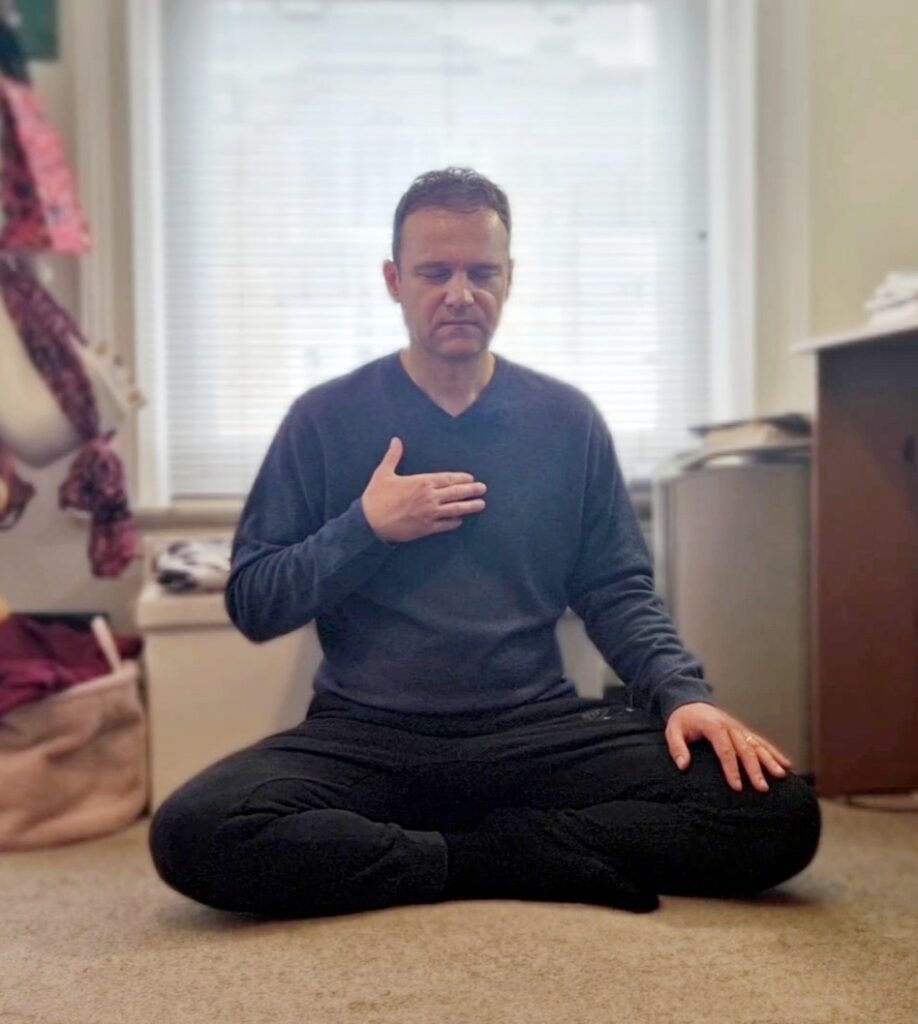
I encourage you to sometimes just sit down and do nothing. Look around you and inside yourself, listen to the sounds and just be still for a short time. It might enrich your life in ways you cannot even imagine.
Everything I have written here is only words. Now let them go.